“30th Sunday – Fine mild morng. Wind S, but at 12 O’Clock came out fresh from N.W. and was very cold ~ Rode over to the Orchard & call’d at Furley ~ Jn. & Hy. Moore came out to dinner, and Geo & Jn Brown in the evg. Aother Lamb today ~
From the journal of Captain Henry Thompson, January 30, 1814. Courtesy the Friends of Clifton.
“29 – Weather still fine, Wind NW Went to Town din’d with Mr. Wirgmans A Lamb last Night – Pd Vache
From the journal of Captain Henry Thompson, January 29, 1814. Courtesy the Friends of Clifton.
“28 – Remarkably fine day, after a frosty Night went to Town, return’d to dinner –
From the journal of Captain Henry Thompson, January 28, 1814. Courtesy the Friends of Clifton.
“27th Jany – Very find day, hard Frost last night Wind N.W. Went to Town, din’d at Mr. Catons by invitation of Rob Patterson
From the journal of Captain Henry Thompson, January 27, 1814. Courtesy the Friends of Clifton.
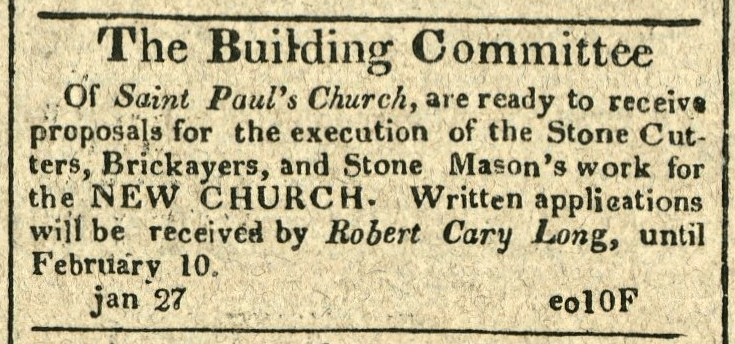
American and Commercial Daily Advertiser, January 27, 1814.
“26 – Weather still fine. Wind N.W. Went to Town. return’d to dinner, at which had the following company – Gen. Ridgely, Mr. Nicols, Lorman, A Brown, Hu Thompson, Dr. Stewart, D.A. Smith, Tennant, Nicols, P. Hoffman, Hall Harrison, R. Patterson, W. Lorman, S. Sterrett, Chs. S. Ridgely, Jas. Sterrett.
From the journal of Captain Henry Thompson, January 26, 1814. Courtesy the Friends of Clifton.
Cartoon of the hydrophobia panic of 1826, courtesy HistoryToday
On January 26, 1814, a group of local doctors, including Dr. Henry Wilkins, James Smith, William Donaldson, Samuel Baker, James Page, and Elisha DeButts, established the “Beneficial Society for prevention of hydrophobia.”
Hydrophobia (better known today as rabies) was a terrifying prospect in many American cities throughout the 19th century. Stray dogs ran rampant and a single bite from an infected animal might mean a painful death. In his brief medical history of Baltimore, Dr. John Morris observed, “Hydrophobia is noted as a cause of death in all the early records of the city but there are only one or two deaths reported annually.”
In 1814, the cause of the disease still remained a mystery but Dr. Henry Wilkins, one of the founding members of the Beneficial Society, sketched out his approach to treatment in an 1811 letter that prescribed the application of a caustic paste onto any bite from an infected animal. Thankfully, a more effective cure arrived in 1885 when Louis Pasteur and Émile Roux developed the first rabies vaccine.
Read more on the 19th-century history of rabies in Mad Dogs and Englishmen by Neil Pemberton and Michael Worboys on HistoryToday, 2007.
“25 – Very fine day & mild, Wind NW – Went to Town return’d to Dinner
From the journal of Captain Henry Thompson, January 25, 1814. Courtesy the Friends of Clifton.
On January 25, 1814, mechanic John Owings received two patents for the design of a new water mill and an impressed roller for the production of “knives, spoons, etc.” Born in Baltimore around 1780, Owings lived in the city’s Western Precincts at Paca and Franklin Streets. He later served as a Captain under Colonel Jessop in the 36th Regiment of the Maryland Militia.
“24 – Commenc’d raining before day & continued until 2 PM Wind South Went to Town in my Gig, drove Jack the Mule, return’d to Dinner Hung up remainder of my Bacon
From the journal of Captain Henry Thompson, January 24, 1814. Courtesy the Friends of Clifton.