All posts by Baltimore Heritage

Maryland and Pennsylvania charter the Baltimore and Strasburg Turnpike Company

Report on the highways of Maryland, 1899

On January 24, 1814, the Maryland legislature joined Pennsylvania in chartering a new turnpike company to connect Lancaster County to Baltimore. The state offered a detailed and descriptive title: “An act to enable the governor of this commonwealth to incorporate a company for making an artificial road by the best and nearest route from the Philadelphia and Lancaster turnpike road through the village of Strasburg in Lancaster county to the Susquehanna bridge at McCall’s ferry and from thence to Baltimore.”

In the 1810s, states established countless turnpike companies but road-building remained a potentially challenging and speculative venture. Some projects like the Baltimore and Havre-de-Grace Turnpike (chartered in 1813 but unfinished until 1825) took years to complete. Others, including this road from Baltimore to Strasburg, were never built at all.

Advertisement: Public Dinner to Commodore Perry

Public Dinner to Commodore Perry
American and Commercial Daily Advertiser, January 24, 1814

On January 6, Commodore Oliver Hazard Perry received a Congressional Gold Medal for his service at the Battle of Lake Erie. Make sure to sign up for our email newsletter to get more updates on Perry’s celebratory visit to Baltimore at the end of the January 1814.

Jan. 22nd
At half past 11 A.M. lat. 31, 48, long. 70, 20, discovered a sail from mast head, distant about 15 miles; made all sail in chase, it blowing fresh and squally. – At 5 P.M. the chase hoisted the American ensign at the main peak; at the same time made her out to be a foretopsail schooner – shewed our American ensign and continued under a press of sail to chase, coming up very fast, the chase at this time being distant about two and a half miles.  At half past 9, lost sight of her in a squall, when about to fire a chase gun.

From the journal of the Chasseur, excerpted in Baltimore American, June 2, 1814. Maryland Historical Society.

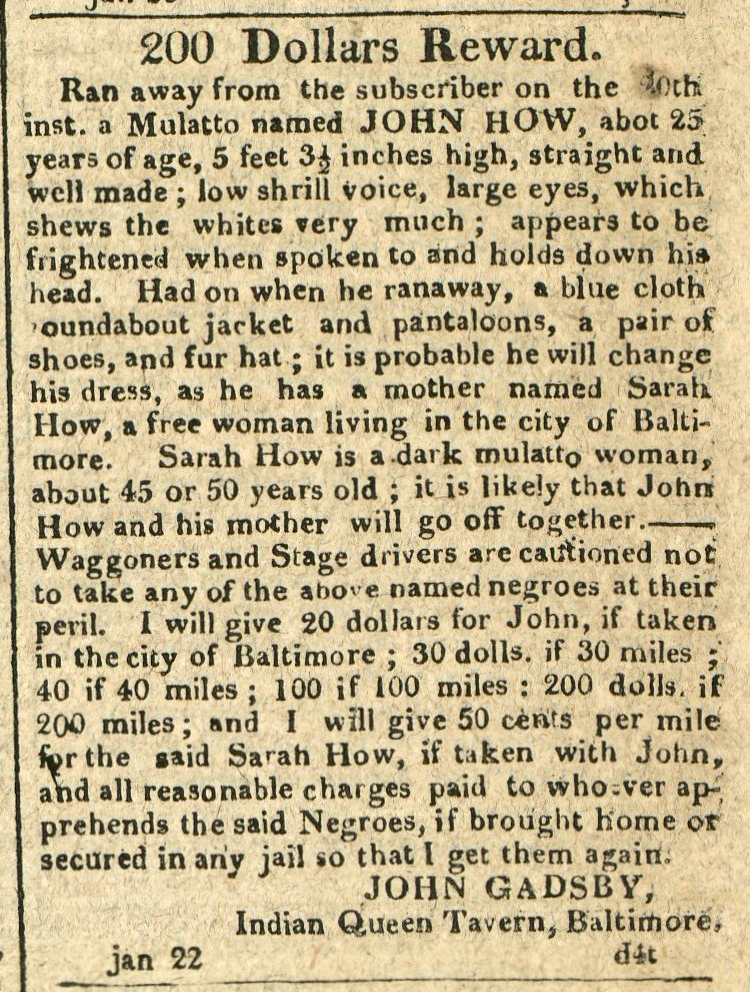
Advertisement: 200 Dollars Reward

American and Commercial Daily Advertiser, January 22, 1814

John Gadsby, the English-born proprietor of the Indian Queen Tavern, had arrived in Baltimore from Alexandria, Virginia in 1808. On September 29, 1809, traveler Samuel Breck stopped in Baltimore and stayed at the Indian Queen, observing:

“We alighted at the Indian Queen in Market street, kept by John Gadsby in a style exceeding anything that I recollect to have seen in Europe or America. This inn is so capacious that it accommodates two hundred lodgers, and has two splendid billiard-rooms, large stables and many other appendages. The numerous bed-chambers have all bells, and the servants are more attentive than in any public or private house I ever knew.”

In 1813, John Gadsby held thirty-six enslaved people at the Indian Queen to support the “attentive” service of his establishment. According to the 1813 Baltimore tax records, the value of the enslaved people held by just twelve tavern or innkeepers exceeded the total value of their real estate.

Sources: Breck, Samuel, and Horace Scudder. 2007. Recollections of Samuel Breck. Applewood Books. p. 266Rockman, Seth. 2010. Scraping By: Wage Labor, Slavery, and Survival in Early Baltimore. JHU Press. p. 112.

Wendel Bollman, self-taught engineer and “Master of the Road,” born in Baltimore

Wendel Bollman, C.E. (1814-1884)
Photo courtesy of Dr. Stuart Christhilf from The Engineering Contributions of Wendel Bollman, 1966.

On January 21, 1814, Ann B. Bollman and Thomas Bollman welcomed the birth of their son Wendel Bollman. Thomas Bollman worked as a baker with a shop at the corner of Water Street and Public Alley (known as Grant Street today) and served in the militia during the Battle of Baltimore.Thomas Bollman died at age 44 on April 17, 1819 when Wendel was only 5 years old.

When Wendel was a teenager, nearly 14 years after the Battle of Baltimore, he joined a group of local boys marching in a parade to celebrate the construction of the Baltimore & Ohio Railroad on July 4, 1828. Over the next few decades, thousands of people from Baltimore joined the railroad and Wendel Bollman among them. His career was more exceptional than most, however, as in 1848, he became the “Master of the Road” for the B&O. Bollman is remembered as an exceptional self-taught engineer whose innovative iron bridges the helped support the rapid growth of the railroad in the 1850s and 1860s.