Jan. 12 – Fine clear cool day Wind N.W. – Went to Town return’d to Dinner, sold Chester to Mr. Nicols for $200 –
From the journal of Captain Henry Thompson, January 12, 1814. Courtesy the Friends of Clifton.
Jan. 12 – Fine clear cool day Wind N.W. – Went to Town return’d to Dinner, sold Chester to Mr. Nicols for $200 –
From the journal of Captain Henry Thompson, January 12, 1814. Courtesy the Friends of Clifton.
11 – Clear & cold, hard Frost last night, Went to Town, din’d at S. Sterrets – A meeting of the Horse Artillery at my Counting House to Elect their Officiers, this evening. Haul’d 9 loads of Ice today, which filled the house, containing 54 loads. Mr. Nicols call’d this evening.
From the journal of Captain Henry Thompson, January 11, 1814. Courtesy the Friends of Clifton.
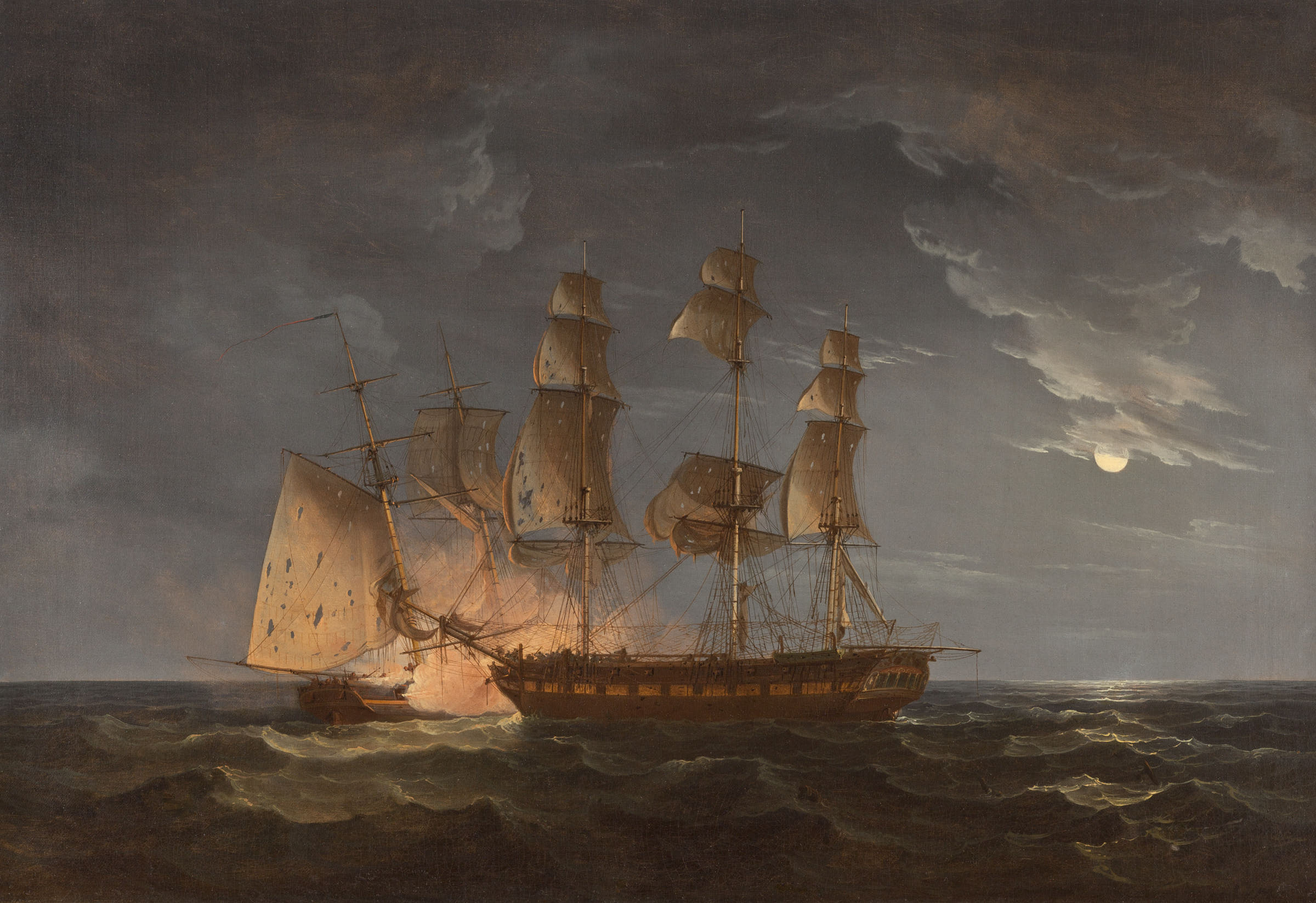
On January 11, 1814 at half-past midnight, the British ship Hibernia fought desperately against an attack by The Comet. Over a year before, in December 1813, the 187-ton Baltimore-built Comet slipped past a British blockade of the Chesapeake Bay and sailed south towards the Caribbean. The ship’s captain, Thomas Boyle, carried a letter of marque from President James Madison—one of five hundred letters Madison issued authorizing private ships to bring the fight to British shipping across the Atlantic.
In a little over a year at sea, Boyle and his crew recorded an astonishing twenty-seven prizes. They were on their way back to Baltimore when the ship spotted and engaged the 800-ton Hibernia in the early afternoon of January 10. After hours of maneuvers and exchanges of cannon fire that continued into the morning hours of January 11, both ships were badly damaged.
Contradictory accounts of the conflict do leave some room for interpretation. British sources, including excerpts from the British ship’s log, suggest the Hibernia was disabled, with only six cannons and a skeleton crew but still managed to kill twenty of Boyle’s crew in a desperate defense. Popular American sources describe the Hibernia differently—a formidable opponent with twenty-two guns and a full crew that left the Comet badly despite Boyle’s brave assault.
The battle ended inconclusively before dawn. The Comet retreated to Puerto Rico for repairs before finally returning home in Baltimore on March 17.
10 Clear’d up. Wind NW but mild – Went to Town din’d at Gadsbys – Snow was about nine inches deep this morning but has diminish’d very much today, being very mild and no Sleighing.
From the journal of Captain Henry Thompson, January 10, 1814. Courtesy the Friends of Clifton.
Baltimore Jany. 9th 1815 [1814]
Sir,In reporting to you the advancement of my ship I have the honor to state, that we got our topmasts on end to day—that our lower rigging is rattled down, and catharping’d in.
The Hold is nearly stowed.— and I intend our yards shall be across next week. I shall stand in need of my sails from Washington.
Had I my compliment of men, I could be ready for sea in three weeks.—
My residing within a hundred yards of my ship since appointed to her, and giving personal attention to every little thing will account to you for my rapid progress.— The “Erie” has more men, but in other respects the “Ontario” is equally advanced. Indeed we have little the start! With great respect your very Obt. ServantR. T. Spence
From a January 9, 1814, letter by Master Commandant Robert T. Spence to Secretary of the Navy William Jones. The Naval War of 1812: A Documentary History, Volume III, p.19
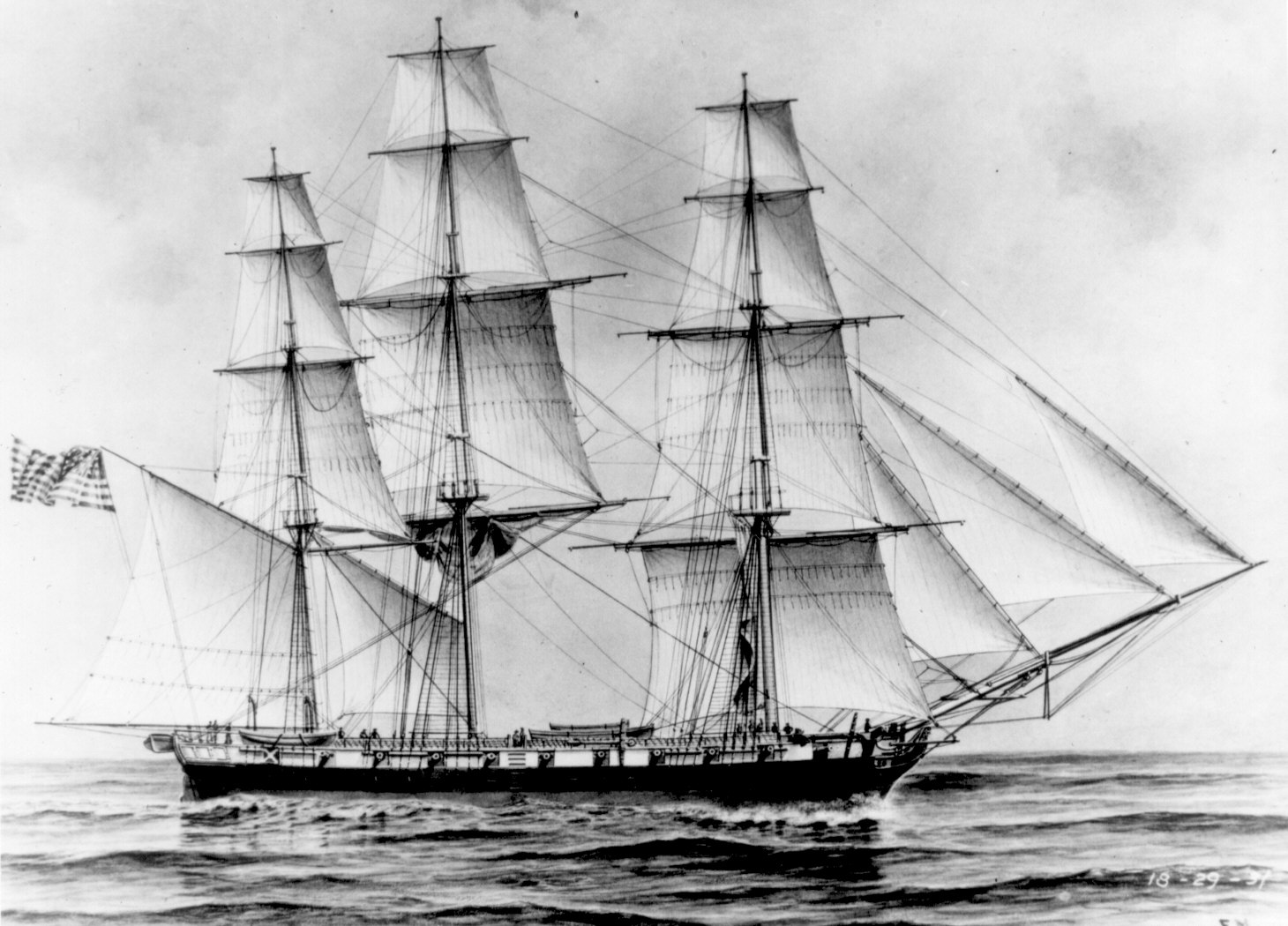
On March 3, 1813, the United States Congress authorized the construction of six sloops-of-war. Naval architect William Doughty designed three of the six ships and directly supervised the construction of the USS Argus at the Washington, DC shipyards. In Baltimore, Thomas Kemp took Doughty’s designs and began work on the remaining two, the USS Ontario and USS Erie, at his Fell’s Point shipyard.
The Erie launched from the shipyard on November 3, 1813 and The Ontario followed on November 28, 1813. Master Commandant Robert T. Spence, commander of the USS Ontario, spent the winter months of 1814 struggling to recruit enough men to set sail—a delay that ultimately kept the Ontario stuck in Baltimore behind the British blockade of the Chesapeake through the end of the war.
Sunday 9 – Cloudy morning Wind NE – Commenc’d snowing at 12 O’Clock and continued all day & Night, but not cold – Remain’d at home & no visitors –
From the journal of Captain Henry Thompson, January 9, 1814. Courtesy the Friends of Clifton.
Subscribe to receive our weekly updates by email or check out our review of stories from January 1-8, 1814 on the Baltimore Heritage blog.
8 – Fine day, went to Town, return’d to Dinner – Haul’d 24 Lods of Ice today with two Carts, which is very great work. – House nearly full.
From the journal of Captain Henry Thompson, January 8, 1814. Courtesy the Friends of Clifton.

On January 7, 1814, the United States Patent Office granted John H. Guiramand a patent for his new design for a power loom. Born in Lyon, France, John Guiramand, known as Jean Pierre Morel de Guiramand, moved to the French colony of Saint-Domingue. When the Haitian Revolution began in 1791, Guiramand joined hundreds of white French colonists in fleeing the island and moving to Southern American cities like Baltimore.
In 1814, Guiramand’s work was part of a wave of invention sweeping the growing American textile industry. Between 1810 and 1820 alone, the U.S. Patent Office recorded thirty-eight patents for power looms. First invented in 1784, the power loom connected traditional textile looms to water wheels (and later steam engines) to speed up the weaving process. Like many other American “inventors” in early 1800s, Guiramand may have closely copied his design on models already in use in France or England. In February 1814, Guiramand advertised the “New Invented & Patented Loom” in the American and Commercial Daily Advertister boasting:
“[Guiramand] has invented a loom, which although extremely simple possesses greater advantages than any heretofore known… A child 10 or 12 years old, may learn to use it in a couple of hours.”
Unfortunately, the exact nature his invention remains a bit obscure: the first 10,280 patents issued between 1790 and 1836 burned up in an 1836 fire and only around 2,800 of those lost have ever been recovered.
7th – Fine day, and having Frozen for a week past, commenc’d filling my Ice House, haul’d 21 loads today with two Carts from Herring Run Went to Town return’d to Dinner
From the journal of Captain Henry Thompson, January 7, 1814. Courtesy the Friends of Clifton.