Subscribe to receive our weekly updates by email or check out our review of stories from January 9-15, 1814 on the Baltimore Heritage blog.
All posts by Baltimore Heritage
On January 15, 1814, Ramsay McHenry was born to Daniel William McHenry and his wife Sophia Hall Ramsay. The child was the first grandson of Fort McHenry namesake James McHenry, a Revolutionary War veteran who served as a personal secretary to General George Washington and as the nation’s first Secretary of War. James McHenry had poor health throughout his life and, in early 1814, experienced a serious paralysis from which he never fully recovered:
“Though he was but little over sixty years of age McHenry’s health which had never been robust was entirely shattered by his attack of paralysis and from the beginning of 1814 he was almost a helpless invalid.”
Ramsay McHenry lived in Harford County up until his death on August 13, 1878. He served several terms in the state legislature, “took a great interest in agriculture and possessed fine herds of imported cattle,” and never married.
Source: Steiner, Bernard Christian. 1907. The Life and Correspondence of James McHenry: Secretary of War Under Washington and Adams. The Burrows Brothers Company.
15 – Cloudy morning Wind South – Went to Town & rode to dine with D.A. Smith & a small party, commenc’d raining at 5 O’Clock& has not ceas’d at bed time – Had three Lambs last Night
From the journal of Captain Henry Thompson, January 15, 1814. Courtesy the Friends of Clifton.
Advertisement: Lost, Thomas Tenant’s Note
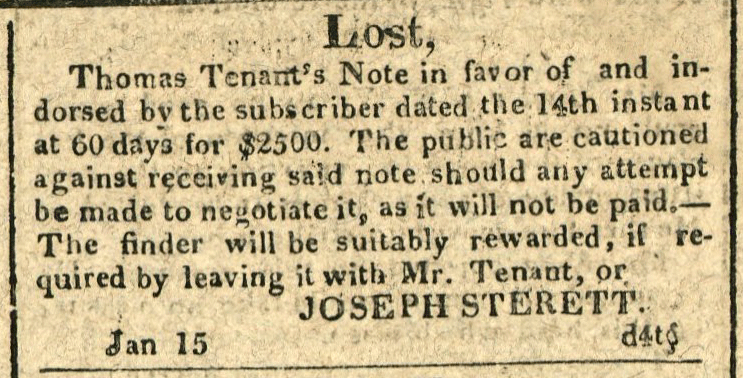
Joseph Sterett (1773-1821) was a wealthy land-owner, merchant and planter who commanded the Fifth Regiment of Maryland militia at the Battle of Bladensburg and Battle of North Point. Thomas Tenant (1769–1836 was a Federalist, a Baltimore merchant, shipowner, wharf owner, and prize agent who served as a major in the Sixth Regiment of the Maryland militia.
How did Sterett lose a $2500 check from Tenant? Share your theories in the comments!
14 – Very fine day & rather more mild – went to Town, retun’d to dinner with Jn. Moore. Mr. Vanwyck & S. Sterrett who return’d home before Sunsett Two Lambs last Night & two today
From the journal of Captain Henry Thompson, January 14, 1814. Courtesy the Friends of Clifton.
Advertisement: Rumour upon Rumour or one good chance for speculation Yet left.

13th – Weather continues clear & cool – Went to Town, din’d at P. Wirgmans who had a Family party – Ram Lamb last Night –
From the journal of Captain Henry Thompson, January 13, 1814. Courtesy the Friends of Clifton.
Advertisement: Wanted Immediately At the Powhattan Cotton Works
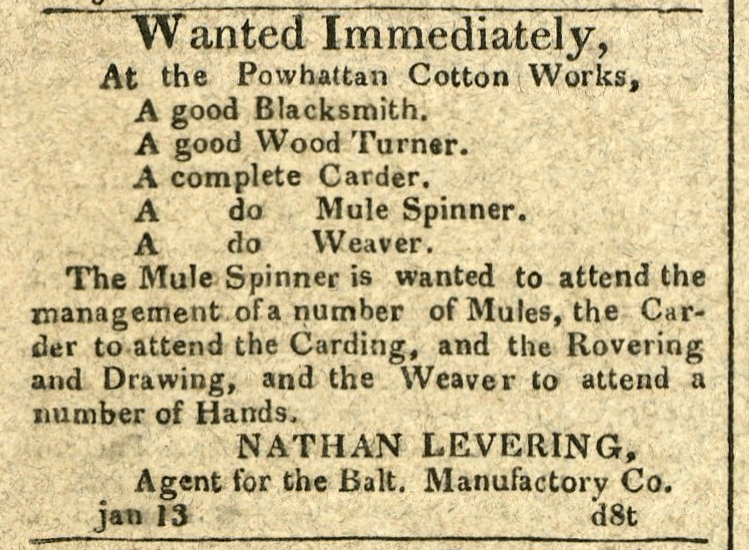
One of the earliest textile factories in Baltimore, the Powhatan Cotton Works was built by the Baltimore Manufacturing Company along the Gwynns Falls, six miles from the city and started production in 1811.
Advertisement: For Sale… the Privateer Schooner Chasseur, now ready to sail
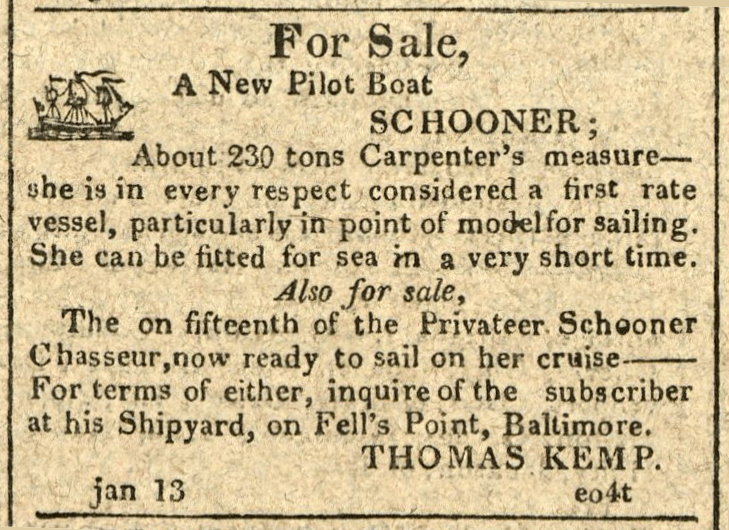
On January 13, 1814, Thomas Kemp advertised the “Privateer Schooner Chasseur” for sale and Captain William Wade prepared to take the ship out on its first cruise. Built by Thomas Kemp for local merchant William Hollins, the Chassuer launched on December 12, 1812 but failed miserably in two attempts to evade the British blockade of the Chesapeake on commercial ventures with the second trip ending in mutiny.
Captain William Wade took command in February 1813 after the ship received a privateer commission and brought recent experience privateering as a second officer on the Comet under Captain Thomas Boyle. The Chasseur weighed almost twice as much as the Comet (resting in Puetro Rico after a damaging fight with the Hibernia just days earlier) and already had a reputation as one of the fastest top sail schooners built to date. Even with Wade’s experience and the ship’s speed, getting past the British might be a difficult task.
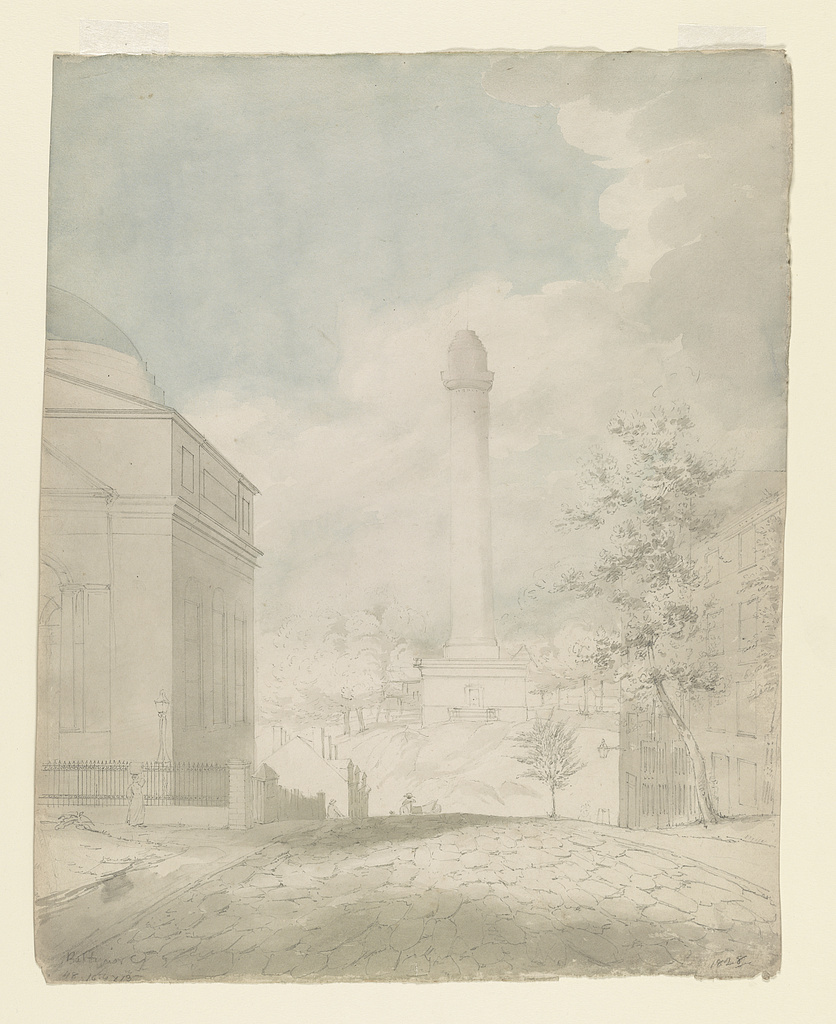
Architect Robert Mills submits a “book of designs” for Baltimore’s Washington Monument

On January 12, 1814, a 33-year-old architect named Robert Mills mailed off a “book of designs” to the Board of Managers of the Washington Monument in Baltimore. Accompanying the dozen drawings and pages of notes describing his design, Mills included a letter making the case for his particular qualifications as an American architect:
Gentlemen,
Through your indulgence in granting me a little time beyond the period fixed upon in your advertisement, for designs for the Monument you purpose to erect to commemorate the inestimable virtues and glorious deeds of the immortal Washington, I have now the honor of submitting to your consideration the result of my labors towards accomplishing the Wishes of your honorable board— Accompanying this letter you will find a book of designs with a description of the Monument….
Being an American by birth and having also the honor of being the first American who has passed through a regular course of study of architecture in his own country, it is natural for me to feel much solicitude to aspire to the honor of raising a monument to the memory of our illustrious countryman. The education I have received being altogether American and unmixed with European habits, I can safely present the design submitted as American founded upon those general principles prefaced in the description contained in the Book of Designs. For the honor of our country, my sincere wish is that it may not be said; To foreign genius and to foreign hands we are indebted for a monument to perpetuate the Glory of our beloved Chief.
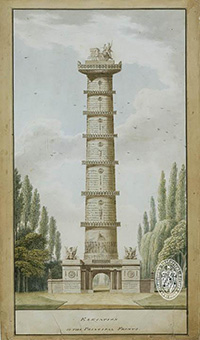
Four years earlier on January 6, 1810, Maryland had authorized the “Board of Managers of the Washington and Monument in Baltimore” to raise funds by lottery to support the design and construction of a monument to George Washington. Delayed by the war and difficulties in raising money, the members of the board voted on February 15, 1813 to hold a design competition with a prize of $500 for the “best design, model or plan for a Monument to the memory of General Washington.”
Robert Mills submitted a detailed description of his proposal back in November along with a few rough sketches. When the board extended competition deadline from January 1 to April 15, it gave him more time to prepare the illustrations contained in his “book of designs,” an essay with a description of the drawings and “a few remarks upon Monuments in general,” and the letter excerpted above.
In claiming the title of America’s first trained architect, Robert Mills played to his strengths despite the debatable nature of his claim. The board’s original announcement for the competition, appearing in the Niles’ Weekly Register on March 20, 1813, remarked:
“it is hoped that the American artist will envince by their productions, that there will be no occasion to resort to any other country for a monument to the memory of their illustrious fellow-citizen.”
Maryland Historical Magazine captured the definitive history of the Washington Monument in an 1939 article where you can find full transcripts of Robert Mills’ proposals and correspondence.
Learn more about the history of the Washington Monument from the Mount Vernon Place Conservancy or on Robert Mills in the excellent history by John M. Bruan: Robert Mills: America’s First Architect.